
How Do You Engineer Hype? Inside the System Behind India’s Comet Sneakers
What an Indian sneaker brand can teach founders about positioning, product moats, and designing community into every drop.

There’s a lazy way to explain why some brands catch fire.
You say they had taste. Or timing. Or luck. Or a charismatic founder. Or a community that “just formed organically.”
But when you listen closely to how Comet’s founder describes the company, a different picture emerges. The interesting thing is not that Comet built hype around sneakers. The interesting thing is that they seem to have treated hype as something you can design for — not perfectly, not mechanically, but systematically.
That makes this more useful than a startup profile.
Because most products begin life as commodities. Shoes are commodities. Coffee is a commodity. Protein powder is a commodity. Even software, eventually, becomes a commodity. The game is not simply to make the thing. The game is to make the thing mean something.
That is the thread running through this conversation: the shift from product to signal, from catalog to culture, from transaction to belonging.

AI-generated illustration of a story-rich sneaker brand breaking out of a commodity market.
A sneaker is not a shoe once it starts carrying a story
One of the sharpest ideas in the interview is also the simplest: people do not use sneakers only for utility. They use them to signal taste, belonging, personality, status, memory, subculture — some mix of all of the above.
That’s not new, exactly. Humans have always used objects as symbols. But what Comet seems to understand is that a symbol becomes stronger when it carries a story that is specific enough to retell.
A plain premium sneaker says: I spent money.
A shoe built around a mango, an orange, or some other emotionally loaded object says something else: I get the reference. I like the weirdness. I belong to the kind of person who notices this.
That’s a different category of meaning.
In the interview, Utkarsh keeps returning to the idea that shoes can act like a canvas for stories in a way that feels rarer, stranger, and therefore more magnetic than putting the same story on a T-shirt. That rarity matters. If storytelling on a product is common, it stops being a signal. If it’s unusual, it becomes talkable.
And talkability is one of the raw materials of hype.
The market gap was not “more shoes.” It was “better signals.”
A lot of founders claim they found a market gap when what they really found was a supply gap. That’s different.
Comet’s framing is more interesting than that. Utkarsh describes the Indian market as split between two broad worlds: expensive global brands that carry aspiration, and affordable local brands that deliver function but little signaling value.
That leaves a hole in the middle: products that feel aspirational but still feel reachable.
This is not just a pricing gap. It is a meaning gap.
Because if the expensive global brands tell stories that are imported, and the local affordable brands tell almost no story at all, then a homegrown brand has a chance to occupy a very particular emotional space: “This feels like it belongs to my world, but still feels elevated.”
That’s a much better place to build from than “we’re cheaper than Nike.”
The contrarian part is that aspiration here is not being treated as a luxury feature. It is being treated as infrastructure. The brand has to feel cool enough to desire, but not so distant that the customer never enters the game.
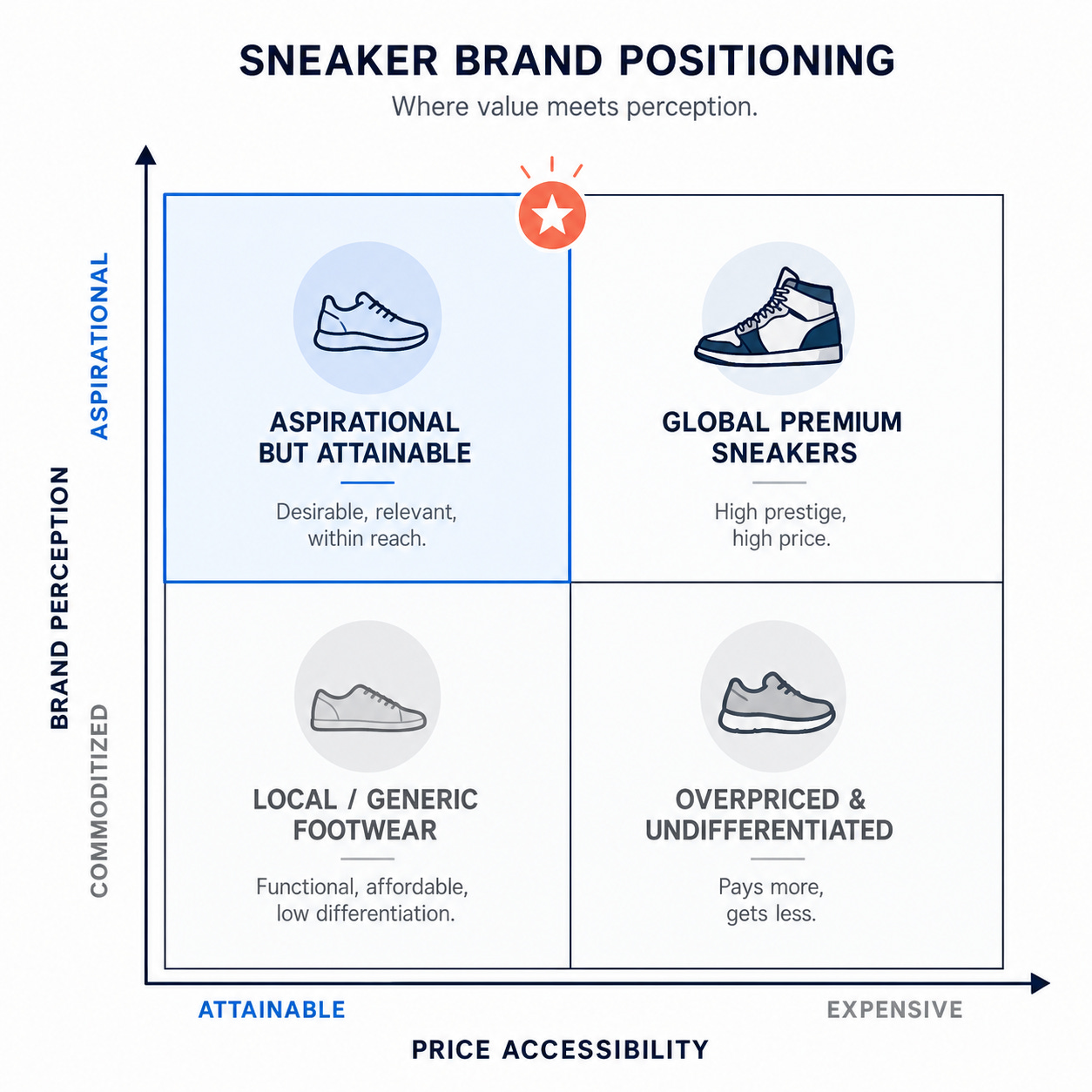
A simple map of the sneaker market: expensive aspiration on one side, generic affordability on the other, with Comet aiming for the space in between.
Instagram is not a shelf. It is a stage.
Another useful idea from the interview: most brands misuse Instagram because they treat it like a catalog.
That sounds obvious once you hear it, but it explains why so many brand accounts feel dead. They have followers, but no energy. Posts, but no anticipation. Presence, but no pull.
Comet’s approach is almost the opposite. Instead of posting endlessly, they focus organic attention around moments that feel like events: unusual products, distinct drops, things people have not seen before.
This matters because platforms punish sameness long before customers do.
If every post looks like another product tile, the brand becomes background noise. But if the feed becomes a place where people expect surprise, design experiments, and stories worth sending to friends, then Instagram stops being a display case and starts becoming distribution in the deeper sense of the word.
That distinction matters far beyond fashion.
A lot of companies think they have a marketing problem when they really have a pattern-breaking problem. Nothing they make earns attention. It may be competent. It may even be high quality. But it does not interrupt the scroll.
The Mango drop in the interview is a good example. It was not just a yellow shoe. It was packaged like a mango crate, with gradients and small details that extended the idea all the way through the object and the unboxing experience. The Orange shoe took the same instinct further: what if the shoe could be peeled like an orange?
These are not merely “creative campaigns.” They are attempts to build products that arrive preloaded with conversation.

Hype looks spontaneous from the outside. From the inside, it is often a designed sequence: emotion, product, packaging, ritual, and sharing.
Hype is what happens when novelty meets ritual
There is a temptation to think novelty alone is enough.
It isn’t.
Novelty gets attention once. Ritual keeps attention coming back.
One of the most important operational details in the conversation is the way Comet structures drops: story-led products, teasers, a launch cadence, timing, anticipation, early access for existing customers, and a scarcity pattern that trains the audience to pay attention.
That combination matters. A weird product without ritual is just a one-off. Ritual without novelty becomes stale. But when the two work together, they create expectation.
And expectation is one of the things people often mistake for hype.
Hype is not just “a lot of people talking.” It is a shared sense that something worth noticing is about to happen.
That’s why the early failure of the Mango drop is actually one of the more valuable parts of the story. According to the interview, it sold only two pairs in three days at first. That detail makes the later story more believable, because it shows that attention had to be trained. The audience had to learn what kind of brand this was.
You do not get that learning by doing one clever thing once. You get it by repeating a coherent pattern until people start anticipating it.
Product still matters more than the story people tell about product
This is where a lot of brand-heavy businesses collapse. They become excellent at talking and shallow at making.
The interview is strongest when it resists that temptation.
Utkarsh is explicit that product is the center of the system: own molds, control materials, obsess over fit and comfort, work deeply with manufacturers, build internal capability instead of simply ordering generic goods from a supply chain and wrapping them in aesthetic language.
That matters because brand without product depth is fragile.
It can buy a moment, maybe even a season. But once people wear the thing, talk to each other, and compare notes, truth catches up.
One reason Comet’s story is worth taking seriously is that the founder does not present storytelling and technical depth as opposites. For them, the story is the invitation. The product is the proof.
That feels right to me.
Too many founders want the benefits of myth without paying the price of rigor. They want the audience to feel something before they have built anything precise enough to deserve the feeling.
Cool is not borrowed. It is risked
The most memorable conceptual distinction in the interview may be the split between passive cool and active cool.
Passive cool is easy. You borrow the visual grammar of what is already accepted as cool: skateboards, basketballs, streetwear poses, familiar iconography. You associate yourself with an existing code.
Active cool is harder. You do something unexpected enough that people have to update their mental model of you.
That might mean a strange product idea. It might mean a retail environment that feels unlike retail. It might mean saying no to the obvious aesthetic shortcuts and building your own visual logic instead.
This is costly. It increases the chance that you look foolish. That is exactly why it works when it works.
There is a broader lesson here beyond branding. In most fields, originality is expensive not because it requires genius, but because it requires exposure. You have to be visibly specific before the world has given you permission to be.
That is true for products. It is true for essays. It is true for careers.

Borrowed signals can make something legible. Original risk is what makes it memorable.
Community is not a bonus. It is part of the product
The last major idea worth stealing is the addition of a fifth P: people.
Not people in the HR sense. People in the sense of customers becoming the system through which the brand compounds.
Comet seems to think about this very intentionally: direct replies in DMs, resharing customer stories, early access for existing buyers, special treatment for fans who already show up in the brand, and hospitality-forward physical experiences at store launches.
You can call that community, but that word has become fuzzy.
A clearer way to say it is this: they are designing moments that make customers feel recognized.
Recognition is one of the most underpriced forces in modern business. Most people are not seen very often. A brand that reflects them back to themselves — stylishly, publicly, generously — can become much more than a store.
That said, this is also one place to be cautious. The interview gives strong anecdotes, not strong metrics. We hear about lines, DMs, early access, and cult energy, but not much about retention curves, repeat purchase rates, or the hard economics of maintaining this level of attention. So I would treat the emotional truth here as strong, and the business generalizability as still partly unproven.
Still, the principle holds: if you want people to market for you, you need to give them something more than a receipt.

The real asset is not only the customer. It is the self-reinforcing loop the customer helps create - delightful experience → sharing → brand amplification → status → stronger demand
The deeper lesson
The biggest takeaway from this interview is not “build a sneaker brand.”
It’s that hype, in the healthiest sense, is what happens when many small choices point in the same direction.
A story-rich product.
A clear position in the market.
A channel strategy built for attention, not mere presence.
A launch rhythm that trains anticipation.
A product good enough to survive the story.
A brand willing to risk originality.
A customer experience that turns buyers into carriers of meaning.
That is a much more demanding playbook than the usual startup clichés. It asks more from the founder. More taste, yes, but also more patience, more operational discipline, more willingness to go deeper on details that do not show up neatly in a dashboard.
Which is probably why it’s rare.
Most companies want the appearance of culture. Few are willing to build the machinery that culture requires.
And that, more than anything, is what made this conversation interesting to me. Not the sneakers themselves. Not even the revenue claim in the title, which should be independently verified before being repeated as fact.
What’s interesting is the possibility that in a world crowded with products, the next durable edge may belong to companies that know how to turn objects into signals, customers into participants, and distribution into theater.
That is not just branding.
That is systems thinking in consumer form.